front desk
Why Your EHR Should Be the Source of Truth for Allergy Practice Booking
2026-10-09 · 3 min read
The Hidden Cost of Disconnected Booking Systems
Your front desk staff juggles three different systems before 9 AM: the practice management software shows Mrs. Chen scheduled for environmental testing, the phone notes say she's coming for a food challenge follow-up, and the EHR indicates she's due for immunotherapy. Which one is correct?
This scenario plays out daily in allergy practices using disconnected booking systems. When scheduling data lives in multiple places — third-party booking platforms, phone logs, sticky notes, and the EHR — the result is predictable chaos. Patients arrive for the wrong appointment type, testing rooms sit empty while consultation slots overflow, and staff spend valuable time reconciling conflicting information.
The solution isn't adding another scheduling tool. It's ensuring your EHR remains the single source of truth for every booking decision.
Why EHR-Centric Booking Matters for Allergy Practices
Allergy practices face unique scheduling complexity that general healthcare booking systems miss entirely. A patient might need skin testing, patch test readings on specific days, immunotherapy injections, and follow-up consultations — sometimes all within the same month. Each appointment type requires different room setups, staff preparation, and time allocations.
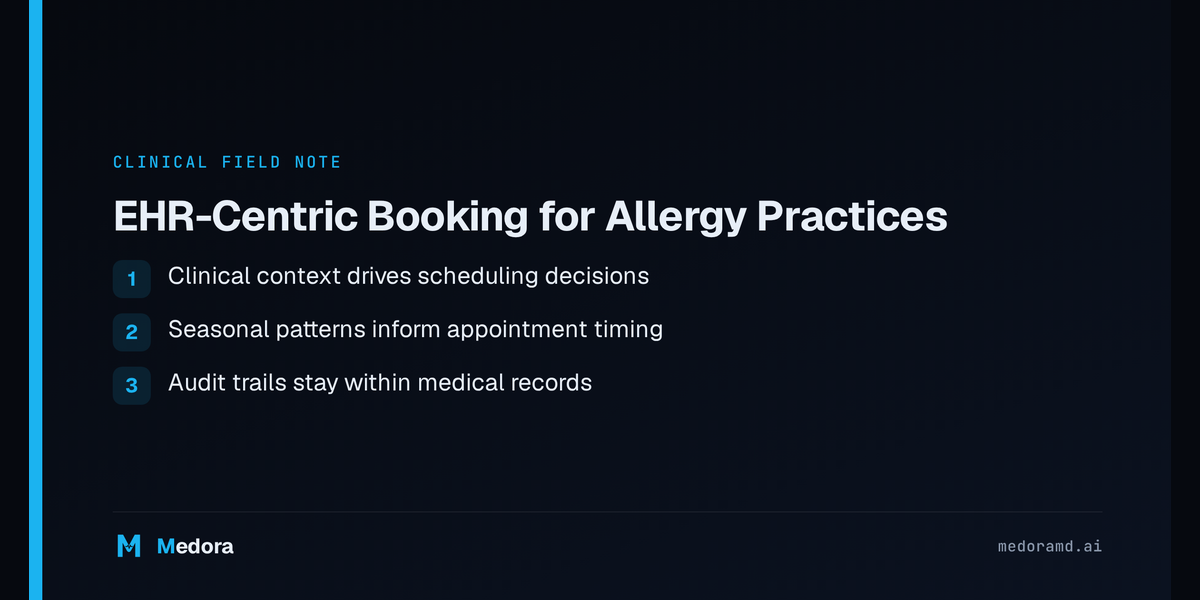
When booking requests bypass the EHR, critical clinical context gets lost. The system that knows a patient's testing history, current immunotherapy protocol, and seasonal patterns should drive scheduling decisions. A patient with a positive penicillin skin test needs different appointment preparation than someone coming for routine environmental testing, but external booking platforms can't access this clinical intelligence.
EHR-centric booking also prevents the documentation gaps that plague audit reviews. Every appointment change, cancellation, or rescheduling creates an audit trail within the patient's medical record. When scheduling data lives outside the EHR, practices lose this critical documentation pathway.
The Real-World Impact of Scheduling Disconnection
Consider the ripple effects when booking systems operate independently of clinical records. A patient books online for "allergy testing" but the system can't distinguish between skin prick tests, intradermal testing, or patch testing. They arrive expecting a 30-minute appointment but need a two-hour environmental panel.
Or worse: a patient schedules through an external platform for immunotherapy, but the EHR shows they're overdue for spirometry. The clinical team discovers this gap mid-visit, disrupting the carefully planned injection schedule and creating downstream appointment conflicts.
These disconnections compound during high-volume periods. Spring ragweed season already strains testing room capacity — adding scheduling confusion makes efficient patient flow nearly impossible.
Building Clinical Intelligence Into Booking Decisions
Modern allergy practices need booking systems that understand clinical context. When a patient requests an appointment, the system should know their testing history, current treatment protocols, and optimal scheduling patterns. A patient on rush immunotherapy needs precise timing intervals that generic booking platforms can't accommodate.
This clinical intelligence extends to staff preparation. When booking systems access this information, staff can prepare appropriately instead of discovering special needs at check-in.
Seasonal patterns matter too. The system should recognize that a patient with spring tree pollen sensitivity might need testing adjustments during peak season, or that patch testing requires specific day-of-week scheduling for proper reading intervals.
The Path Forward for Allergy Practice Scheduling
Effective scheduling in allergy practices requires clinical intelligence, not just calendar management. Your EHR contains years of patient history, treatment protocols, and scheduling patterns that external booking platforms can't replicate. The goal isn't to abandon this clinical intelligence but to extend it beyond business hours while maintaining data integrity.
Practices succeed when they preserve EHR primacy while improving patient access. This means choosing booking solutions that enhance rather than replace existing clinical workflows, ensuring every scheduling decision benefits from the full context of patient care.
How does your practice balance patient scheduling convenience with the clinical intelligence stored in your EHR?
---
Medora Scribe, built for allergy visits. Medora Copilot listens to the allergy visit and drafts an allergy-structured SOAP note, with visit templates for new patients, follow-ups, skin testing, immunotherapy and asthma. The clinician reviews, edits and signs every note. See how Medora Scribe works or start a 14-day free trial, no card needed ($99 per provider per month after the trial).