documentation
The Fragmentation Tax: Why Disconnected Documentation Systems Cost Allergists More Than They Realize
2026-08-31 · 4 min read
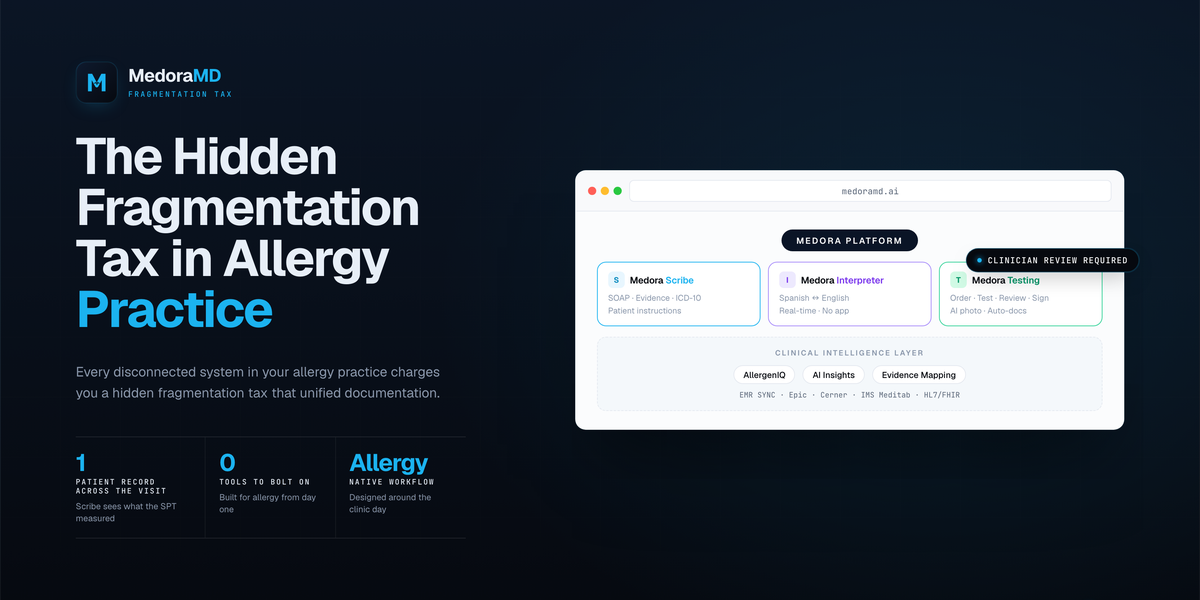
Dr. Sarah Chen finished documenting her last patient at 7:30 PM. She'd seen 28 patients that day, but the real work began after hours: copying notes between systems, reconciling test results with documentation platforms, and re-entering patient instructions that should have carried forward from the ambient scribe to the patient portal. Each disconnected tool in her practice was charging her what we call the "fragmentation tax" — the hidden cost of systems that don't talk to each other.
What Is the Fragmentation Tax?
The fragmentation tax is the cumulative cost — in time, errors, and cognitive load — that allergists pay when clinical systems operate in isolation. Unlike obvious expenses such as software licenses or hardware upgrades, this tax hides in the gaps between tools.
Consider a typical allergy visit workflow:
- Ambient documentation captures the encounter
- Skin test results live in a separate testing module
- Patient instructions require manual entry into yet another system
- Clinical codes need verification across multiple platforms
- Prior visit context requires manual lookup and cross-referencing
Each handoff point charges the fragmentation tax. The allergist becomes a human data bridge, manually connecting information that should flow seamlessly.
The Hidden Costs Add Up
Research on clinical decision support systems reveals how fragmented workflows create cognitive overhead that extends far beyond the immediate task. When clinicians must mentally track patient context across disconnected tools, they're not just losing time — they're paying a tax on their attention and clinical reasoning.
The fragmentation tax manifests in several ways:
Documentation Duplication: When your ambient scribe doesn't connect to your skin testing workflow, you document the same patient twice. The conversation gets captured in one system while test results live in another, forcing manual reconciliation during note finalization.
Context Switching Penalties: Each system switch requires mental recalibration. Moving from an ambient documentation platform to a separate testing interface to a third patient instruction system fragments your clinical thinking.
Error Propagation: Disconnected systems create multiple sources of truth. When patient allergy history exists in your documentation tool but skin test patterns live elsewhere, discrepancies become inevitable.
Cognitive Load Multiplication: Instead of thinking about the patient's clinical picture, you're managing system interfaces. The mental energy spent navigating disconnected tools is energy not spent on clinical reasoning.
Real-World Impact on Allergy Practices
Allergy practices face unique fragmentation challenges. A comprehensive allergy evaluation involves multiple data streams: environmental and food history, medication reactions, prior testing results, current symptoms, and treatment responses. When these elements live in disconnected systems, the fragmentation tax becomes particularly expensive.
Consider immunotherapy management across fragmented systems. The patient's initial evaluation might be documented in one platform, skin testing results in another, and treatment protocols in a third. Each follow-up visit requires manual assembly of this scattered context, turning routine care into a data archaeology project.
The prior authorization burden, as documented in recent research on biologic prescriptions, compounds this fragmentation. When clinical documentation, test results, and treatment histories exist in separate systems, assembling authorization packets becomes an exercise in digital scavenger hunting.
Beyond Time: The Clinical Quality Cost
The fragmentation tax isn't just about efficiency — it affects clinical quality. When relevant patient context requires manual lookup across multiple systems, important details get missed. The subtle pattern connecting a patient's seasonal symptoms to specific environmental exposures might be clear in a unified record but invisible across fragmented documentation.
Pertinent negatives illustrate this challenge perfectly. In a unified system, the fact that you specifically ruled out latex sensitivity during this visit becomes part of the longitudinal record. In fragmented systems, these clinical exclusions often disappear into documentation gaps, forcing future providers to re-ask questions you've already answered.
The Compound Interest of Fragmentation
Like financial debt, the fragmentation tax compounds over time. Each disconnected system adds incremental overhead that multiplies across every patient interaction. A practice seeing 50 patients daily might lose 2-3 minutes per encounter to fragmentation overhead — seemingly small until you calculate the annual cost.
More concerning is the compound effect on clinical continuity. When patient context fragments across systems, each subsequent visit starts with incomplete information. The cognitive work of reassembling patient history becomes a recurring tax on every encounter.
Eliminating the Fragmentation Tax
The solution isn't adding another tool — it's choosing systems designed for unified patient context. When ambient documentation, clinical coding, evidence mapping, and patient instructions operate on the same patient record, the fragmentation tax disappears.
Medora Copilot addresses this fragmentation directly through unified allergy-specific documentation workflows. When you need to pause and resume a recording during a complex visit — perhaps to step out for an urgent call or consult with a colleague — the system maintains your visit context without forcing you to restart or lose captured information. This pause-and-resume capability eliminates the fragmentation that occurs when interrupted visits require switching between systems or manually reconstructing conversation context. The ambient capture, structured SOAP generation, and evidence mapping all operate on the same patient record, ensuring that clinical continuity survives workflow interruptions. Every component — from AllergenIQ profiles to clinical codes to patient instructions — shares unified patient context, eliminating the manual reconciliation work that fragments most documentation workflows.
Engagement Question
What's the most frustrating example of fragmentation tax in your current allergy practice workflow — where do you find yourself manually connecting information that should flow automatically between systems?
See MedoraScribe in your workflow
See how ambient capture, allergy-specific SOAP notes, Evidence Mapping, and
clinician review work together with a synthetic patient demonstration.