documentation
Why Assessment & Plan Generation Is the Hardest Part of Allergy Documentation
2026-09-21 · 5 min read
The Assessment & Plan Bottleneck
Every allergist knows this moment: you've just finished a complex visit with a patient presenting chronic urticaria, possible food sensitivities, and a history of anaphylaxis. The history is clear in your mind, the physical exam findings are documented, but now comes the hardest part — dictating a coherent Assessment & Plan that captures your clinical reasoning while the next patient is already waiting.
The Assessment & Plan (A&P) represents the most cognitively demanding portion of clinical documentation. Unlike the structured data collection of History of Present Illness or Review of Systems, the A&P requires synthesizing multiple data points into clinical judgments, differential diagnoses, and treatment plans. For allergists managing complex cases involving multiple allergens, cross-reactivities, and treatment protocols, this synthesis becomes particularly challenging to articulate cleanly between patients.
Why the A&P Is Uniquely Difficult to Dictate
Traditional dictation works well for factual documentation: "Patient reports onset of symptoms in spring," or "Skin prick tests positive for timothy grass." But the A&P requires translating clinical reasoning into structured prose while maintaining medical accuracy and billing compliance.
Consider a typical allergy visit: A 34-year-old presents with seasonal symptoms, positive environmental allergens on testing, but also reports new-onset reactions to tree nuts. Your clinical reasoning involves weighing the significance of each positive test, considering cross-reactivity patterns, determining immunotherapy candidacy, and addressing the separate food allergy concern. Dictating this reasoning coherently — especially when running behind schedule — often results in fragmented or overly brief documentation.
The cognitive load intensifies when managing multiple conditions simultaneously. Allergists routinely address asthma control, environmental allergies, food sensitivities, and medication allergies within a single visit. Each condition requires its own assessment and plan, but they're interconnected in ways that generic documentation templates cannot capture.
The Hidden Costs of A&P Documentation Struggles
When Assessment & Plan generation becomes a bottleneck, the downstream effects ripple through the entire practice. Providers often defer complete documentation until after hours, leading to the familiar scenario of spending evenings finishing charts. This after-hours documentation burden contributes directly to physician burnout and work-life balance challenges.
From a clinical perspective, rushed or incomplete A&P documentation can compromise care continuity. When the reasoning behind treatment decisions isn't clearly captured, follow-up visits become more difficult. Other providers covering the practice may struggle to understand the diagnostic thinking or treatment rationale.
Billing accuracy also suffers when A&P documentation is inadequate. The Assessment & Plan directly supports medical decision-making complexity, which determines evaluation and management (E&M) coding levels. Incomplete documentation of differential diagnoses, treatment options considered, or risk stratification can result in downcoding and lost revenue.
How AI Scribe Technology Addresses A&P Generation
Modern AI scribe systems designed specifically for allergy practices can capture and structure the Assessment & Plan in real-time during patient conversations. Rather than requiring providers to pause and dictate formal documentation, these systems listen to the natural clinical discussion and generate structured A&P sections that reflect the provider's reasoning.
The key advancement lies in allergy-specific clinical intelligence. Generic AI scribes often struggle with specialized terminology like "oral allergy syndrome," "component-resolved diagnostics," or "cluster immunotherapy protocols." Allergy-focused systems understand these concepts and can accurately capture the nuanced clinical reasoning that allergists use daily.
For complex cases involving multiple allergen sensitivities, AI assistance becomes particularly valuable. The system can track multiple assessment points — environmental allergies, food sensitivities, asthma control, medication reactions — and structure them into coherent plans without requiring the provider to mentally organize the dictation while managing patient flow.
Clinical Workflow Integration
Effective A&P generation requires understanding the natural flow of allergy visits. During patient encounters, allergists often circle back to refine their thinking as new information emerges. A patient might mention a reaction pattern that changes the differential diagnosis, or skin test results might prompt reconsideration of treatment approaches.
AI scribe systems that integrate with allergy workflows can adapt to this iterative clinical reasoning. Rather than requiring linear dictation, they can capture the evolving assessment as the visit progresses and structure the final A&P to reflect the provider's ultimate clinical conclusions.
The system should also understand the relationship between different documentation elements. When skin prick test results are documented, the A&P should logically reference those findings. When discussing immunotherapy candidacy, the reasoning should connect to the patient's allergen profile and symptom severity already captured in the visit.
Quality and Accuracy Considerations
While AI assistance can significantly streamline A&P generation, maintaining clinical accuracy remains paramount. The most effective implementations include provider review workflows that allow clinicians to verify and refine the generated content before finalizing documentation.
Some systems provide real-time feedback during documentation generation, allowing providers to correct or clarify points as the A&P develops. This collaborative approach leverages AI efficiency while preserving clinical oversight and accuracy.
The goal isn't to replace clinical judgment but to reduce the cognitive load of translating that judgment into structured documentation. When providers can focus on patient care rather than documentation mechanics, both clinical quality and efficiency improve.
Medora Scribe: Assessment & Plan Generation for Allergists
Medora Scribe addresses the A&P documentation challenge through real-time capture and structuring of clinical reasoning during allergy visits. Built specifically for allergy and asthma practices, Medora Scribe understands the specialized terminology and clinical patterns that generic AI scribes often miss.
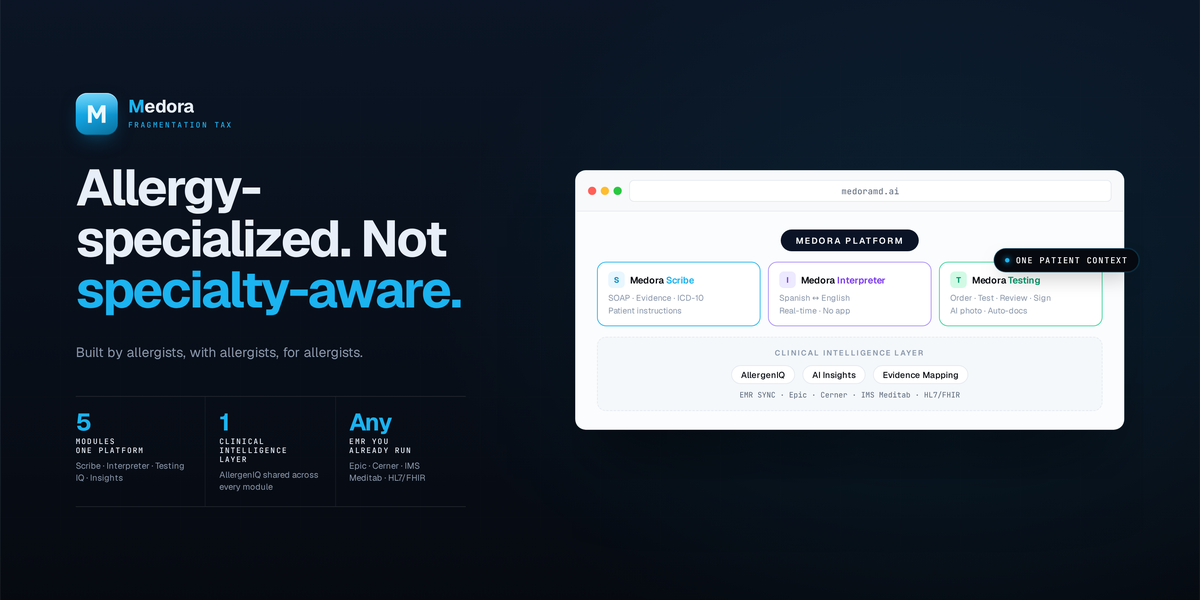
The system captures natural clinical conversations and generates structured Assessment & Plan sections that reflect the provider's diagnostic reasoning and treatment decisions. Because Medora operates as a unified clinical platform, the A&P generation connects seamlessly with other practice workflows — skin test results from Medora Vision inform the assessment, and treatment plans can trigger appropriate follow-up protocols through other Medora modules.
At Allergy Affiliates, providers using Medora Scribe report significantly reduced after-hours documentation time, with particular improvement in A&P completion efficiency. The system's allergy-specific intelligence captures complex clinical reasoning around immunotherapy decisions, food allergy management, and asthma control assessment without requiring structured dictation.
How does your practice currently handle Assessment & Plan documentation for complex allergy patients with multiple sensitivities?
See MedoraScribe in your workflow
See how ambient capture, allergy-specific SOAP notes, Evidence Mapping, and
clinician review work together with a synthetic patient demonstration.