documentation
Ragweed Season Documentation Overload: How Peak Allergy Visits Compound the Fragmentation Tax
2026-08-31 · 4 min read
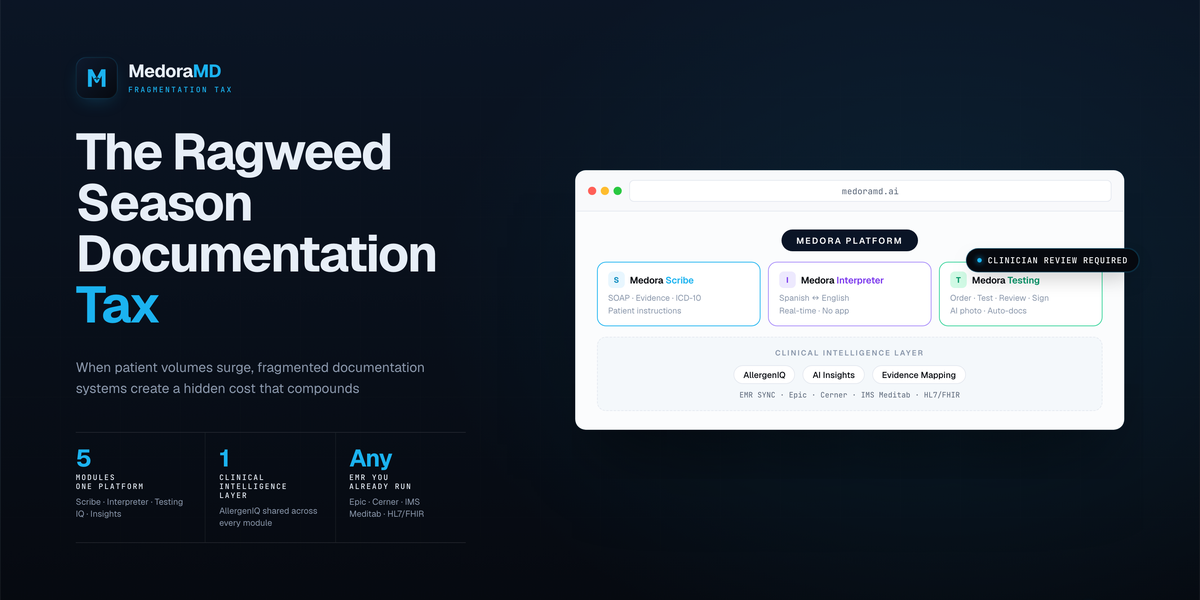
The Ragweed Season Reality
Every August, allergists know what's coming. Ragweed pollen counts climb, patient volumes surge, and suddenly your 15-minute appointment slots feel like 10-minute sprints. But here's the hidden cost most practices don't measure: the documentation burden doesn't just increase proportionally with patient volume—it compounds.
When patient volume climbs during peak ragweed season, you're not just writing more notes. You're context-switching between disconnected systems more often. You're re-documenting the same seasonal patterns in separate tools. You're answering the same follow-up questions because your previous visit notes are buried in a different interface than your current workflow.
The Fragmentation Tax During Peak Season
This is what we call the "fragmentation tax"—the hidden cost of using disconnected clinical tools that don't share patient context. During ragweed season, this tax becomes particularly expensive:
Lost Context Switching: Moving between your EMR, documentation tool, allergy testing software, and patient communication platform can mean losing a few minutes per transition. Across a full clinic day, that interface friction adds up to a meaningful share of clinical time.
Redundant Documentation: Seasonal allergic rhinitis presents similarly across patients, but fragmented systems force you to document the same patterns repeatedly. Your skin testing results live in one system, your visit notes in another, and your patient instructions in a third.
Incomplete Seasonal Patterns: When tools don't communicate, you miss longitudinal insights. Did this patient's ragweed sensitivity worsen since last season? Are their current symptoms consistent with their historical August pattern? Disconnected systems make these clinical connections harder to surface.
The Compound Effect of Volume
Clinical workflow studies suggest that documentation burden does not scale linearly with patient volume. Each additional patient doesn't just add one more note—it adds one more opportunity for context loss, one more chance for incomplete handoffs, and one more instance where fragmented tools slow clinical decision-making.
During peak allergy season, this compounds quickly:
- Week 1: Slightly longer documentation times per patient
- Week 2: Accumulated fatigue from context-switching begins affecting efficiency
- Week 3: Documentation backlogs create pressure to skip thorough review
- Week 4: Provider burnout from administrative overhead peaks
Seasonal Documentation Patterns That Suffer
Certain clinical documentation becomes particularly vulnerable during high-volume periods:
Pertinent Negatives: When you're rushed, it's tempting to document only positive findings. But for allergists, pertinent negatives are crucial—ruling out food allergies, confirming absence of asthma symptoms, or noting lack of eczema flares. Fragmented systems make capturing these negatives feel like extra work.
Prior Visit Context: Returning ragweed patients need continuity. Did last year's immunotherapy help? How did they respond to the previous medication trial? When your current documentation tool doesn't seamlessly surface prior visit context, you're starting each encounter from scratch.
Patient Instructions: Seasonal allergy management often involves detailed environmental controls, medication timing, and follow-up protocols. Disconnected systems mean recreating these instructions for similar presentations instead of building on established patterns.
The Hidden Cost of Peak Season Shortcuts
When documentation systems don't support efficient seasonal workflows, providers develop workarounds that create downstream problems:
- Template Over-reliance: Using generic templates that don't capture patient-specific seasonal patterns
- Incomplete Testing Documentation: Rushing through skin test documentation without proper wheal measurements or reaction notes
- Deferred Patient Communication: Putting off detailed patient instructions until "after the busy season"
These shortcuts might save minutes during the encounter, but they create quality gaps that affect patient care and practice efficiency.
Building Seasonal Resilience
The most efficient allergy practices we've observed share common characteristics during peak season:
- Unified Patient Context: All clinical information—prior visits, testing results, medication trials, patient communications—exists in one accessible view
- Allergy-Specific Templates: Documentation templates built specifically for seasonal allergic rhinitis, environmental allergies, and immunotherapy follow-ups
- Automated Pertinent Negatives: Systems that prompt for relevant negatives without requiring manual recall
- Seamless Patient Instructions: Ability to generate evidence-based patient instructions directly from visit documentation
The Medora Approach to Seasonal Documentation
Medora Copilot addresses seasonal documentation overload through allergy-specific SOAP note generation that captures both positive findings and pertinent negatives from natural conversation. During a ragweed season visit, the system recognizes seasonal patterns while maintaining individual patient context from prior visits.
The key differentiator is unified patient context—when a returning patient discusses this year's symptoms, Medora surfaces last season's presentation, medication responses, and testing results within the same workflow. This eliminates the context-switching tax that compounds during high-volume periods. Every generated note includes clinician review and editing controls, ensuring the final documentation reflects clinical judgment while reducing administrative burden.
How do you maintain documentation quality when ragweed season doubles your patient volume? What workflow changes have you found most effective during peak allergy periods?
See MedoraScribe in your workflow
See how ambient capture, allergy-specific SOAP notes, Evidence Mapping, and
clinician review work together with a synthetic patient demonstration.