documentation
AI Scribe for Allergists: Ambient Listening During Patient Encounters
2026-09-07 · 4 min read
The Typing Trap in Allergy Visits
You're trying to capture the nuanced history of a patient's seasonal symptoms while simultaneously documenting their medication responses, environmental triggers, and family history. Your eyes dart between the screen and the patient as you type, missing subtle facial expressions that might reveal anxiety about their upcoming skin test or confusion about their inhaler technique.
This is the documentation dilemma facing allergists today. Traditional clinical documentation forces a choice: maintain eye contact and risk incomplete notes, or document thoroughly and sacrifice patient connection. For allergy practices managing complex histories, multiple allergens, and detailed treatment plans, this tension becomes particularly acute.
Ambient AI listening technology offers a different approach. Instead of typing through the encounter, AI scribe systems capture the natural conversation between allergist and patient, generating structured clinical notes without requiring active documentation during the visit.
How Ambient AI Listening Works in Allergy Practice
Ambient AI listening uses advanced speech recognition and natural language processing to capture clinical conversations in real-time. Unlike traditional dictation systems that require specific commands or structured speech, ambient technology listens to natural dialogue between clinician and patient.
The system identifies clinically relevant information from the conversation—symptoms, triggers, medication responses, physical exam findings—and structures this into standard SOAP note format. For allergy practices, this means capturing complex histories involving multiple environmental and food triggers, seasonal patterns, and treatment responses without manual documentation.
Key Components of Ambient Documentation
Real-time conversation capture: The system listens continuously during the patient encounter, identifying clinical content within natural dialogue.
Clinical context recognition: Advanced algorithms distinguish between casual conversation and clinically relevant information, focusing on symptoms, treatments, and clinical decision-making.
Structured note generation: Raw conversation data transforms into organized clinical documentation following standard formats familiar to allergists.
Provider review and editing: The generated note requires clinician review and approval before becoming part of the medical record, maintaining clinical oversight and accuracy.
The Clinical Impact: Beyond Time Savings
While reduced documentation time is valuable, the deeper benefit lies in restored patient connection. When allergists aren't focused on typing, they can better observe patient reactions, catch subtle clinical cues, and engage in more thorough clinical reasoning.
For allergy practice specifically, this enhanced attention proves particularly valuable. Allergic reactions often involve subjective symptoms—itching severity, breathing difficulty, quality of life impact—that require careful listening and observation to fully understand. Ambient documentation allows allergists to focus entirely on these clinical nuances.
The technology also supports more comprehensive history-taking. Instead of rushing through questions to minimize typing time, allergists can explore symptom patterns, trigger identification, and treatment responses more thoroughly, knowing the conversation is being captured accurately.
Addressing Common Concerns
Allergists considering ambient AI listening often raise several practical questions:
Accuracy with medical terminology: Modern systems include extensive medical vocabularies and can recognize allergy-specific terms, medication names, and clinical concepts. However, provider review remains essential for clinical accuracy.
Patient privacy: HIPAA-compliant systems encrypt all audio data and maintain strict security protocols. Many patients actually prefer ambient documentation to having their physician type throughout the encounter.
Integration with existing workflows: Effective ambient systems integrate with existing EMRs and practice management systems, minimizing workflow disruption.
Implementation Considerations for Allergy Practices
Successful ambient AI implementation requires thoughtful planning around practice-specific workflows. Allergy visits often include multiple components—history, physical exam, skin testing, treatment planning—each with different documentation needs.
Consider how ambient technology fits within your current visit structure. Some practices use ambient listening for initial consultations and follow-up visits while maintaining traditional documentation for procedures like skin testing or immunotherapy administration.
Staff training proves crucial for optimal results. While ambient systems require less active documentation, providers benefit from understanding how to speak clearly, pause appropriately for system processing, and efficiently review generated notes.
The Future of Clinical Documentation
Ambient AI listening represents an evolution in clinical documentation philosophy—from active transcription to passive capture. As the technology continues improving, we can expect even more sophisticated clinical intelligence, including automated clinical decision support and evidence-based treatment suggestions integrated into the documentation workflow.
For allergy practices managing increasingly complex patients and regulatory requirements, ambient documentation offers a path toward more sustainable practice models that prioritize patient care over administrative burden.
Medora Scribe: Ambient Intelligence for Allergy Practice
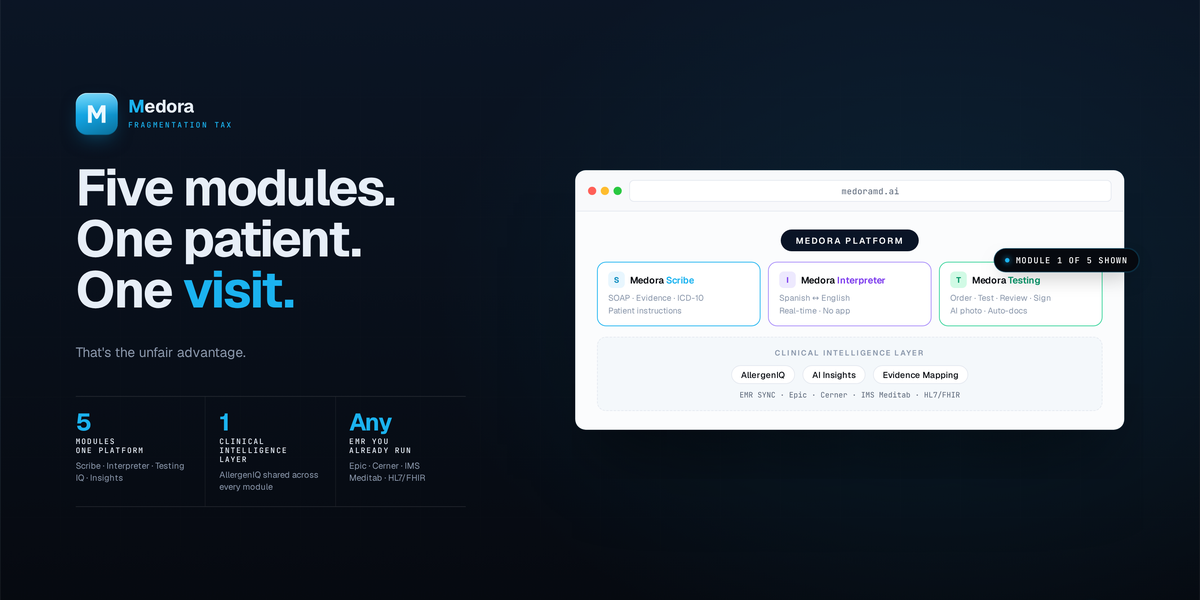
Medora Scribe brings ambient AI listening specifically to allergy and asthma practices. Built by allergists who understand the unique documentation challenges of allergy care, Medora Scribe captures complex allergy histories, recognizes specialty-specific terminology, and generates structured notes that integrate seamlessly with existing EMR workflows.
Unlike generic AI scribes, Medora Scribe operates within a unified patient context—when you perform skin testing with Medora Vision or use Medora Interpreter for patient communication, that information flows directly into your clinical documentation. This eliminates the fragmented workflows that force allergists to re-document information across multiple systems.
At Allergy Affiliates, our beta partner clinic, Medora Scribe has enabled providers to focus more fully on patient care while maintaining comprehensive clinical documentation. The system learns each provider's documentation style over time, creating increasingly personalized note structures that match individual clinical preferences.
How does your practice currently handle documentation during complex allergy consultations, and what impact does typing have on your patient interactions?
See MedoraScribe in your workflow
See how ambient capture, allergy-specific SOAP notes, Evidence Mapping, and
clinician review work together with a synthetic patient demonstration.