
From 9 PM Documentation to 5 PM Freedom: Breaking the After-Hours Charting Cycle
The 9 PM Ritual Every Allergist Recognizes
It’s 9:17 PM. You’re finally sitting down to finish today’s documentation. The SPT results from this morning need structured notes. The complex food allergy case from 2 PM requires careful SOAP formatting. The immunotherapy adjustment from late afternoon is still waiting in your queue.
Sound familiar? You’re not alone. The after-hours charting cycle has become so normalized in allergy practices that we’ve forgotten it’s a choice, not a requirement.
Why Allergists Chart After Hours: The Fragmentation Problem
The evening documentation burden stems from a fundamental issue: fragmented workflows that force repetitive data entry. Here’s the typical allergy clinic day:
– Morning SPTs: Nurse measures wheals, writes on paper, hands off verbally
– Patient encounters: Provider takes mental notes, captures key points
– Between patients: Quick documentation attempts, often incomplete
– End of day: Reconstruct encounters from memory and scattered notes
Each handoff loses context. Each system requires re-entry. By evening, you’re not just documenting—you’re reconstructing entire patient encounters from fragmented pieces.
The Hidden Cost of Documentation Fragmentation
Recent research in Applied Clinical Informatics highlights how healthcare digitalization has paradoxically increased documentation burden for specialists. The promise of electronic health records was efficiency. The reality? More clicks, more fields, more time.
For allergists specifically, this fragmentation creates unique challenges:
Cross-reactivity tracking: When SPT results live in one system and clinical notes in another, pattern recognition suffers. That birch-apple connection might be obvious in person but invisible in disconnected documentation.
Immunotherapy management: Dose escalations, reaction tracking, and adjustment rationale require longitudinal context that fragmented systems can’t provide.
Patient education consistency: Instructions given verbally during visits often don’t align with written materials, creating confusion and safety gaps.
Real-World Impact: The Allergy Affiliates Experience
Allergy Affiliates, a multi-provider practice, tracked their documentation patterns before implementing unified clinical tools. The findings were striking:
– Average evening documentation time: 90+ minutes
– Provider sign-off delays: 18 minutes per SPT session
– Documentation errors: Frequent mismatches between verbal handoffs and written notes
The root cause wasn’t provider inefficiency—it was system fragmentation forcing redundant work.
Breaking the Cycle: Unified Patient Context
The solution isn’t working faster or staying later. It’s eliminating the fragmentation that creates evening work in the first place.
Unified documentation means every piece of patient information—from SPT measurements to clinical assessments—feeds into one coherent record. When the morning’s skin test results automatically inform the afternoon’s clinical note, reconstruction becomes unnecessary.
Real-time capture eliminates the memory tax. Instead of mentally tracking complex cases until evening, structured documentation happens during the encounter when details are fresh.
Automated handoffs remove the telephone game between clinical staff and providers. When SPT measurements flow directly into provider review queues with visual context, verbal summaries become redundant.
The 5 PM Test: What Unified Systems Enable
Practices using unified clinical systems report a fundamental shift: documentation completion during clinic hours, not after.
At Allergy Affiliates, 60 days into their unified system pilot:
– Provider sign-off time dropped from 18 minutes to 4 minutes per SPT session
– Evening documentation sessions decreased from 90+ minutes to under 20 minutes
– Clinical accuracy improved with automated cross-checks and pattern recognition
The key insight: when systems share patient context, providers document once instead of reconstructing repeatedly.
Practical Steps Toward Documentation Freedom
Audit your handoff points: Where does patient information transfer between people or systems? Each transfer point is a potential fragmentation source.
Track evening documentation time: Measure your current after-hours burden. You can’t improve what you don’t measure.
Evaluate system integration: Do your SPT results, clinical notes, and patient instructions share the same patient record? If not, you’re paying the fragmentation tax.
Consider unified platforms: Tools designed specifically for allergy workflows can eliminate the context-switching that drives evening work.
The Technology That Supports This Workflow
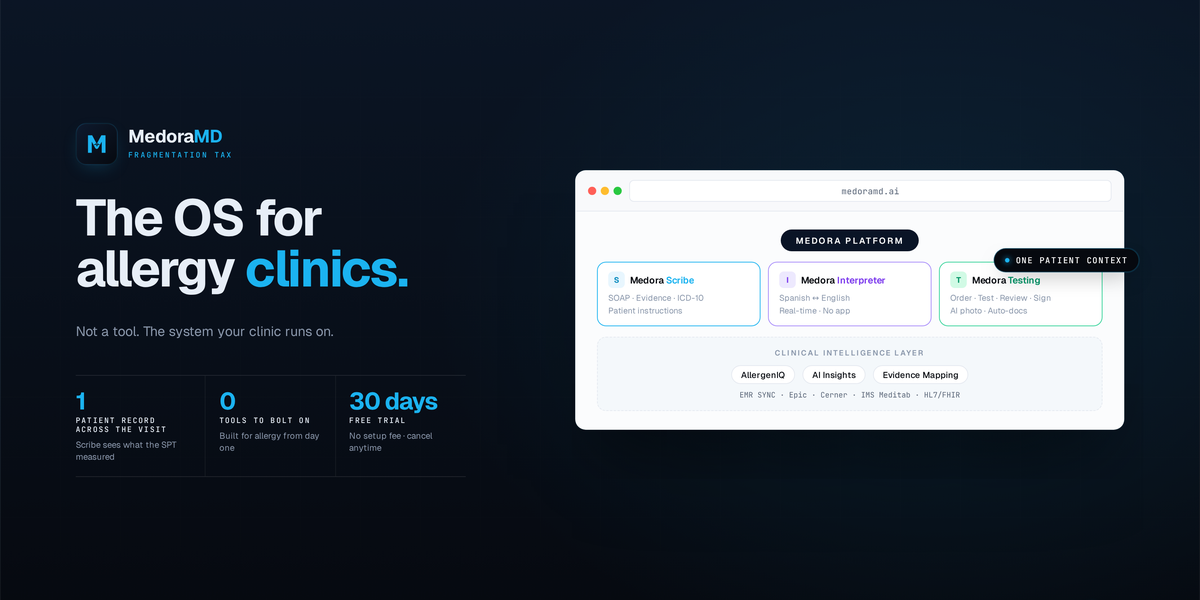
Modern allergy practices are adopting AI-assisted documentation tools that maintain unified patient context across all clinical activities. For example, Medora Scribe captures clinical encounters in real-time while automatically incorporating SPT results measured earlier by nursing staff. This unified approach means providers review complete, contextualized notes rather than reconstructing encounters from memory.
The key differentiator isn’t the AI itself—it’s the unified patient context that eliminates redundant documentation across different clinical activities.
Your Path to 5 PM Freedom
The after-hours charting cycle isn’t a badge of dedication—it’s a symptom of fragmented systems. When every clinical activity feeds into one patient record, documentation becomes a real-time process, not an evening reconstruction project.
What does your current evening documentation routine tell you about system fragmentation in your practice?
See how Medora works in a real allergy clinic.
From ambient SOAP notes to AI-assisted skin prick test reading — see what Medora can do for your practice.