clinical ai
The Intake Questions That Save the Allergy Visit
2026-10-05 · 4 min read
The Pre-Visit History That Changes Everything
When your patient walks into the room, you have fifteen minutes to gather history, examine, interpret testing results, and make treatment decisions. But if you're starting from scratch—asking about symptom timing, triggers, and previous treatments—half that time disappears before you reach the clinical decision-making that matters.
The solution isn't faster questioning. It's smarter intake that captures the right details before the encounter, so your room time focuses on interpretation and care planning. Allergy AI systems and structured pre-visit workflows can reshape this dynamic, but only if they capture the specific elements that drive allergist decision-making.
The Three Categories That Matter Most
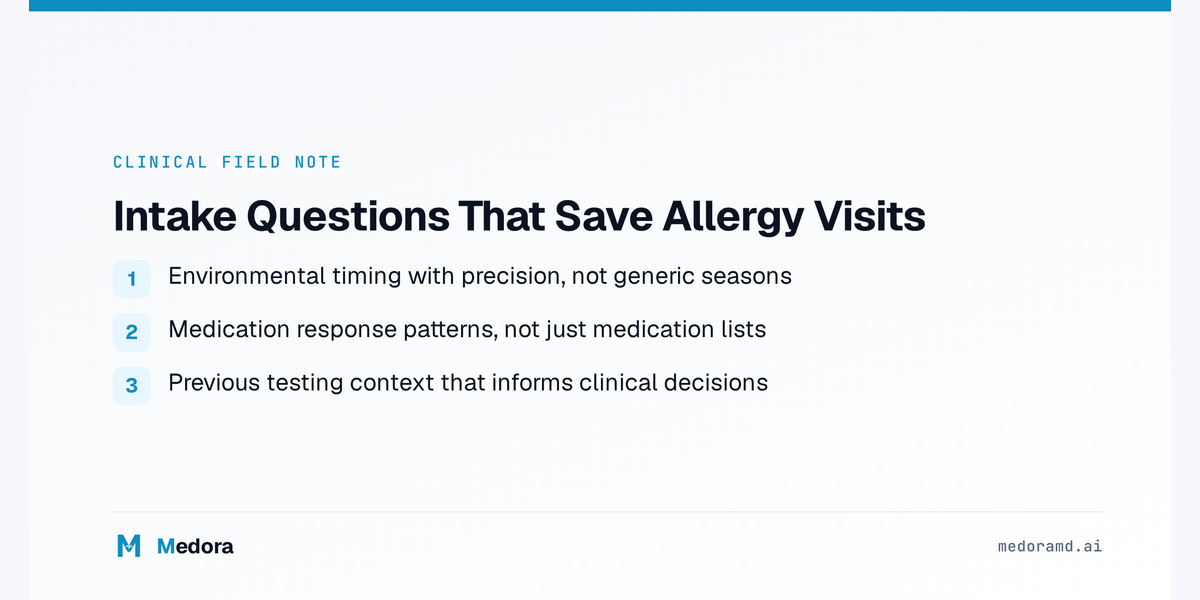
Environmental Context and Timing
Generic intake forms ask "Do you have seasonal allergies?" The question that saves time: "Which months are your worst symptoms, and what were you doing when they started?" This distinction separates the patient whose August symptoms began after moving near ragweed from the one whose started after adopting a cat.
Capture geographic history systematically. The patient who lived in Arizona for ten years but developed rhinitis only after moving to Georgia likely has different sensitivities than the lifelong Southerner with identical symptoms. Document occupational and hobby exposures: the weekend gardener, the woodworker, the teacher in the portable classroom.
Most importantly, establish symptom periodicity with precision. "Spring allergies" could mean March tree pollen or May grass—a distinction that changes your testing approach entirely. Pre-visit intake should nail down: specific months, daily timing patterns, relationship to indoor versus outdoor activities, and response to weather changes.
Medication History and Response Patterns
The intake question "What medications have you tried?" generates lists. The question that informs decisions: "What happened when you took each medication, and why did you stop?" This reveals whether the patient never found relief, had side effects, or simply didn't take medications consistently.
Document specific responses to antihistamines, nasal corticosteroids, and leukotriene modifiers separately. The patient who gets drowsy from cetirizine but tolerates loratadine has different treatment options than the one who finds all oral antihistamines ineffective. Capture duration of trials—the patient who tried fluticasone for three days had a different experience than the one who used it consistently for six weeks.
For asthma patients, pre-visit intake should establish current control patterns: rescue inhaler frequency, night wakening, exercise limitations, and peak flow patterns if available. This baseline assessment determines whether you're optimizing current therapy or stepping up treatment intensity.
Previous Testing and Treatment Context
Many patients arrive with some testing history, but generic intake captures this poorly. The essential pre-visit questions: "When were you last tested, what method was used, and what actions resulted from those results?" A patient with positive skin tests from five years ago who never started immunotherapy has a different clinical picture than one who completed a full course.
Capture immunotherapy history with specificity: which allergens, what duration, response pattern, and reason for discontinuation. The patient who stopped after two years due to inconvenience may restart more readily than the one who stopped due to systemic reactions.
Document previous elimination diets, environmental modifications, and their outcomes. The family that removed carpet and saw improvement has validated their dust mite sensitivity. The one that tried elimination diets without clear benefit may need different food allergy evaluation approaches.
Making Pre-Visit History Actionable
The goal isn't comprehensive documentation—it's targeted information that changes your clinical approach. Effective allergy documentation software should flag the details that matter: the patient whose symptoms worsen in hotel rooms (suggesting dust mite sensitivity), the one whose spring symptoms disappeared during a California trip (pointing toward regional pollen), or the child whose asthma improved dramatically on vacation (indicating home environmental triggers).
Structured intake also reveals gaps in previous care. The patient with clear seasonal patterns who's never had environmental testing, or the one with persistent asthma who's never tried controller therapy, enters your exam room with a clearer pathway forward.
Clinical intelligence for allergists means surfacing these decision-relevant patterns before the encounter begins. When pre-visit documentation captures symptom timing, medication responses, and testing context systematically, your fifteen minutes shifts from information gathering to clinical reasoning.
Medora Copilot structures this pre-visit information capture specifically for allergy practices, ensuring that the history questions that drive allergist decision-making—environmental timing, medication response patterns, and previous testing context—are documented systematically before the encounter. Because all Medora modules share one patient context, when you review the AI-generated note during the visit, the environmental history, medication trials, and testing background are already structured and ready to inform your clinical decisions.
How does your practice currently capture the environmental and medication history that drives your testing and treatment decisions?
---
Medora Scribe, built for allergy visits. Medora Copilot listens to the allergy visit and drafts an allergy-structured SOAP note, with visit templates for new patients, follow-ups, skin testing, immunotherapy and asthma. The clinician reviews, edits and signs every note. See how Medora Scribe works or start a 14-day free trial, no card needed ($99 per provider per month after the trial).