clinical ai
How Allergy AI Gets Built: When Nurses and Allergists Drive the Roadmap
2026-10-02 · 4 min read
The Problem with Healthcare AI Built in Isolation
Most healthcare AI companies build in Silicon Valley conference rooms, then wonder why their products feel foreign in real clinics. They create solutions for problems they imagine exist, not the daily friction points that actually slow down patient care.
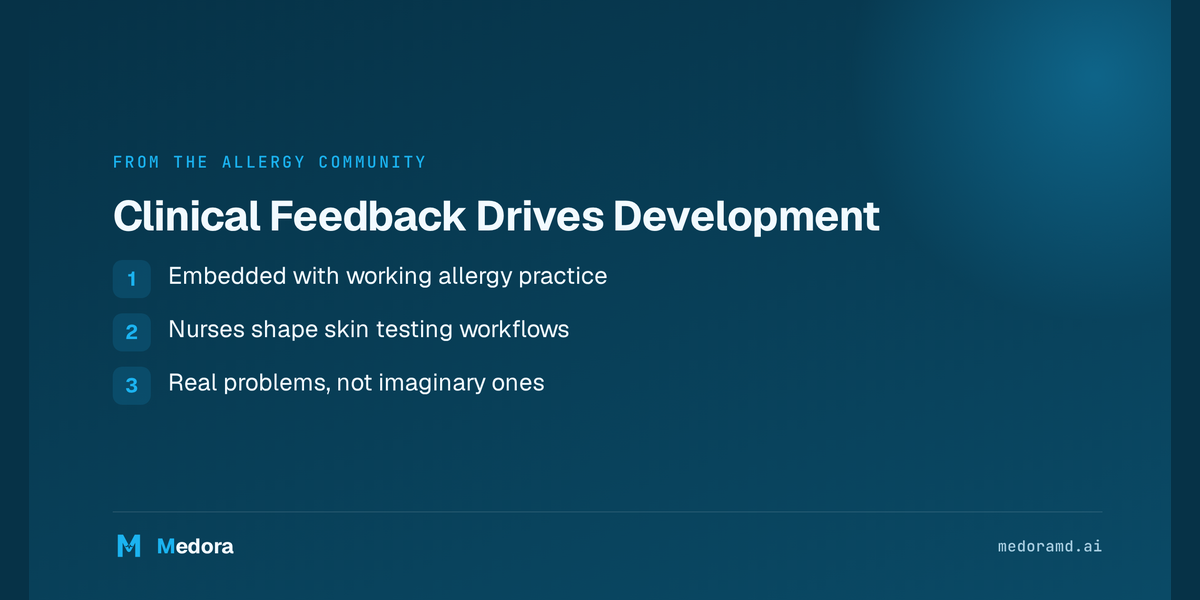
At Medora, we took a different approach. We embedded our development process inside a working allergy practice — Allergy Affiliates — where nurses, allergists, and clinical staff use our Clinical Intelligence for Allergists every day and tell us exactly what works, what doesn't, and what needs to exist next.
Real Feedback from Real Clinical Workflows
When you build allergy AI alongside practicing allergists, you discover things that no amount of market research reveals. The feedback isn't theoretical — it comes from Tuesday afternoon skin testing sessions, Thursday evening documentation catch-up, and Friday morning prior-auth battles.
Take Medora Vision, our photo-documented skin testing module. The original concept focused on wheal measurement precision. But nurses at Allergy Affiliates quickly pointed out that measurement wasn't their biggest pain point — it was the documentation handoff. They needed the system to capture not just wheal sizes, but also patient positioning notes, reaction timing, and control verification in a format that made provider sign-off faster.
That feedback led to a complete redesign. Instead of just proposing measurements, Medora Vision now creates structured documentation that flows directly into the clinical note. The nurse confirms every reading (the system never measures autonomously), but the provider gets a complete picture without having to reconstruct what happened from scattered notes.
When Clinical Staff Shape the Product Roadmap
The most valuable feedback often comes from unexpected moments. During a busy ragweed season, the front desk staff mentioned that patients kept calling to ask whether their symptoms meant they needed to come in early for their next immunotherapy injection. These weren't emergency calls, but they interrupted clinical workflows dozens of times per week.
That observation sparked development of enhanced patient communication features within Medora Front Desk. Instead of generic appointment reminders, the system now helps practices send condition-specific guidance that reduces unnecessary calls while ensuring patients know when to seek care.
The Documentation Burden Reality Check
Allergists told us something that surprised our initial assumptions: the problem wasn't writing notes faster — it was writing notes that actually captured clinical reasoning without requiring extensive post-visit editing. Speed without accuracy just creates more work later.
This insight shaped how we built Medora Copilot, our Allergy Documentation system. Rather than rushing to generate notes quickly, we focused on capturing the nuanced clinical thinking that allergists actually need to document. The system learns each provider's documentation patterns and surfaces relevant cross-reactivity information from AllergenIQ at the right moments.
Evidence Mapping: Born from Provider Skepticism
One of our most requested features came from provider skepticism, not enthusiasm. Allergists wanted to verify exactly where each statement in their AI-assisted notes originated from the patient conversation. They didn't want to trust the system — they wanted to audit it.
This led to Evidence Mapping, where every clinical statement in the SOAP note links back to the specific moment in the conversation transcript. It's not about proving the AI is perfect; it's about giving clinicians the transparency they need to review and refine their documentation with confidence.
The Unified Context Advantage
Working within a real practice revealed why disconnected tools create so much friction. When the skin testing system doesn't talk to the documentation system, nurses end up re-entering wheal measurements, and providers can't see test results while reviewing notes.
Every Medora module — Copilot, Vision, Interpreter (early access), Front Desk, AllergenIQ — operates on the same patient context. What the nurse records during skin testing is immediately available when the provider reviews the note. What the front desk captures during scheduling flows into the clinical encounter. This unified approach emerged from watching how information actually moves through allergy workflows.
What We're Still Learning
Building alongside clinicians also reveals limitations honestly. AI documentation isn't perfect yet — it occasionally misses nuanced clinical reasoning or requires significant editing for complex cases. But by acknowledging these gaps openly, we can focus development on the areas where Allergy Practice AI genuinely reduces documentation burden without compromising clinical accuracy.
The feedback loop continues daily. When a provider mentions that immunotherapy dosing decisions need better historical context, that becomes a development priority. When nurses suggest that skin testing workflows could integrate better with patient education, we explore how to make that happen.
Building for Evidence-Based Care
Perhaps most importantly, working with practicing allergists keeps us focused on supporting evidence-based clinical decisions rather than replacing clinical judgment. The goal isn't to automate away the allergist's expertise — it's to give them better tools to apply that expertise efficiently.
Medora's Clinical Intelligence for Allergists emerged from this philosophy. Rather than suggesting diagnoses or treatments, the system surfaces relevant information, documents clinical reasoning clearly, and reduces the administrative burden that keeps allergists away from direct patient care. Every feature gets tested against real clinical scenarios before it reaches other practices.
This approach takes longer than building in isolation, but it produces tools that actually fit how allergy practices work. When your development team includes the people who will use the product every day, you build something that enhances clinical workflows rather than disrupting them.
How does your team handle feedback integration when implementing new clinical tools?
---
Medora Scribe, built for allergy visits. Medora Copilot listens to the allergy visit and drafts an allergy-structured SOAP note, with visit templates for new patients, follow-ups, skin testing, immunotherapy and asthma. The clinician reviews, edits and signs every note. See how Medora Scribe works or start a 14-day free trial, no card needed ($99 per provider per month after the trial).