documentation
Evidence Mapping: Linking Clinical Notes to Visit Conversations in Allergy Practice
2026-10-07 · 3 min read
The Documentation Verification Challenge
When reviewing an AI-drafted note, allergists face a fundamental question: how do I know this accurately reflects what the patient said? Traditional verification methods require reading through the entire note against memory or playing back lengthy visit recordings—both time-consuming approaches that can delay sign-off well into evening hours.
This verification challenge becomes particularly acute in allergy practices where detailed history-taking drives diagnosis. A patient's description of seasonal patterns, food reaction timing, or family history of atopic disease directly influences testing decisions and treatment plans. When these details appear in an AI-drafted note, the clinician needs confidence they're accurate before signing off.
What Evidence Mapping Brings to Clinical Documentation
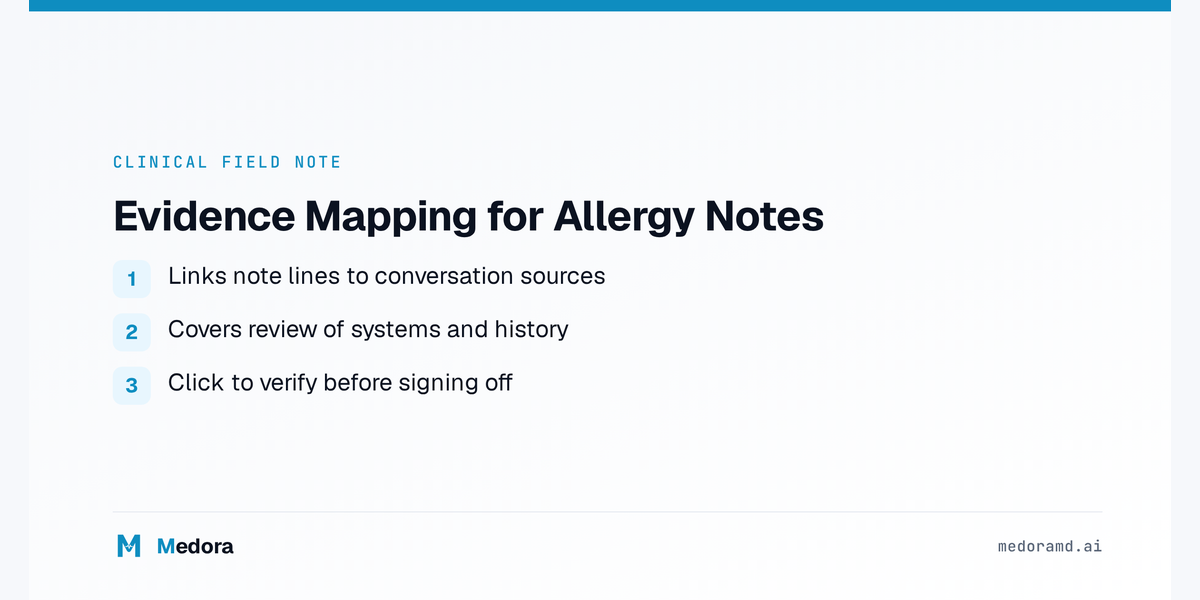
Evidence Mapping addresses this verification challenge by linking lines in the SOAP note back to specific moments in the visit conversation where they were said. Rather than trusting an AI-generated summary, clinicians can click on documented statements to see their source in context.
Recent advances in clinical AI have made this granular linking possible for more sections of the note. As of October 2026, Evidence Mapping now extends beyond the assessment and plan to include review of systems and past, family, and social history—the sections where allergy practices capture much of their diagnostic detail.
The same applies to family history of asthma, previous reaction descriptions, or social factors like pet exposure.
Verifying Complex Allergy Histories
Allergy patients often present with intricate symptom patterns spanning multiple triggers and timeframes. A patient might describe reactions to tree nuts that began in childhood, environmental allergies that emerged in adulthood, and recent medication sensitivities. Evidence Mapping allows allergists to verify each component of this history independently.
Confirming Environmental Trigger Patterns
Seasonal and perennial environmental allergies require precise documentation of trigger patterns, symptom timing, and geographic factors. Patients often provide nuanced descriptions: "Symptoms are worse in spring, but only when I'm outdoors before 10 AM" or "Moving from Arizona helped, but the ragweed here in September is brutal."
Evidence Mapping lets allergists verify these specific environmental details appeared in the patient's own words, ensuring testing panels and treatment recommendations align with the actual history provided.
Family History Verification for Genetic Risk Assessment
Family history significantly influences allergy risk stratification and testing approaches.
The Clinical Intelligence Advantage
Evidence Mapping represents a shift from trusting AI output to verifying it efficiently. Rather than choosing between thorough verification (time-consuming) and quick sign-off (potentially inaccurate), allergists can spot-check specific documented statements that influence clinical decisions.
This targeted verification approach proves particularly valuable for complex allergy patients where multiple triggers, reaction patterns, and family factors intersect.
Implementation in Practice Workflow
Evidence Mapping integrates into existing note review workflows without requiring additional training or workflow changes. Citation markers appear on linked lines in new notes, but the note text itself remains unchanged. Clinicians who prefer traditional review methods can ignore the markers; those who want source verification can click to see the conversation context.
For practices using ambient documentation, Evidence Mapping provides the verification layer that makes AI-assisted notes clinically reliable. The technology handles the time-consuming task of linking statements to sources, while the clinician retains control over what to verify and when.
Medora's Evidence Mapping Implementation
Medora's Evidence Mapping links lines throughout the SOAP note back to visit conversation moments, with recent expansion to include review of systems and past, family, and social history sections. As part of Medora's unified clinical intelligence platform built specifically for allergy practices, Evidence Mapping shares patient context with other modules—so the skin test results recorded by nursing staff appear alongside the drafted note during review.
This integrated approach means allergists can verify documented history while simultaneously seeing objective test data, creating a complete clinical picture for sign-off decisions. The system maintains HIPAA compliance with AES-256 encryption and runs on dedicated AWS infrastructure designed for healthcare applications.
Evidence Mapping operates as one component of Medora's broader mission: reducing documentation burden while maintaining clinical accuracy. By making verification efficient rather than eliminating it, the technology supports thorough clinical practice within realistic time constraints.
---
Medora Scribe, built for allergy visits. Medora Copilot listens to the allergy visit and drafts an allergy-structured SOAP note, with visit templates for new patients, follow-ups, skin testing, immunotherapy and asthma. The clinician reviews, edits and signs every note. See how Medora Scribe works or start a 14-day free trial, no card needed ($99 per provider per month after the trial).