
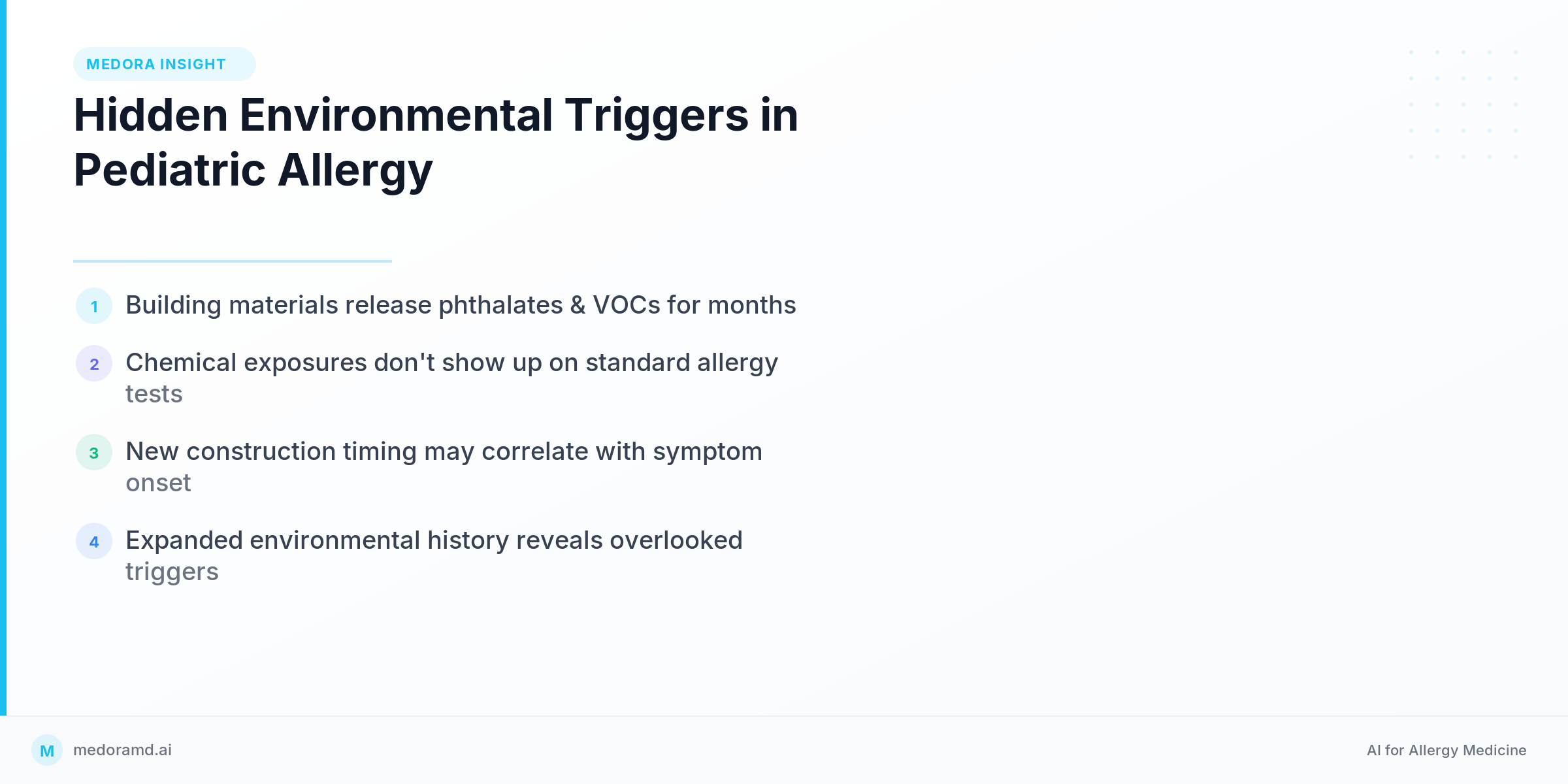
The Hidden Environmental Triggers in Your Patients’ Homes: From Building Materials to Household Chemicals
The Case That Changed My Perspective
Last month, I saw a 7-year-old with persistent asthma symptoms that weren’t responding as expected to standard treatment. The family had moved to a newly constructed home six months earlier. During our visit, the mother mentioned they’d been dealing with “new house smell” and had recently installed vinyl flooring in the child’s bedroom. That conversation led me down a research path that’s reshaping how I think about environmental triggers.
Beyond the Usual Suspects
We’re well-trained to ask about pets, dust mites, and outdoor allergens. But emerging research suggests we may be missing significant indoor environmental factors that contribute to pediatric allergic disease. Recent studies indicate that common building materials and household chemical products are associated with current asthma and allergic symptoms in children in ways we’re just beginning to understand.
The challenge isn’t that we don’t care about environmental factors—it’s that the connections between specific indoor exposures and symptoms can be subtle and delayed. A child’s reaction to phthalates in vinyl flooring or volatile organic compounds from paint may not present as clearly as a cat allergy.
The Building Materials Connection
Preliminary research points to associations between certain indoor building materials and increased rates of childhood asthma and allergic symptoms. These materials are ubiquitous in modern construction:
Flooring Materials: Vinyl and laminate flooring can release phthalates and formaldehyde. Early research suggests neonatal urinary phthalate metabolite concentrations may be associated with the development of atopic dermatitis, though further studies are needed to establish causation.
Paint and Coatings: Low-VOC doesn’t mean no-VOC. Even “safe” paints can off-gas compounds that may trigger respiratory symptoms in sensitive children.
Adhesives and Sealants: These often-overlooked materials can be significant sources of chemical exposure, particularly in newly constructed or recently renovated homes.
Composite Wood Products: Particle board, plywood, and MDF can release formaldehyde for months or years after installation.
Household Chemical Exposures
Beyond building materials, everyday household products may contribute to allergic sensitization:
Cleaning Products: Frequent use of certain cleaning chemicals has been associated with increased respiratory symptoms in children. The “clean smell” parents associate with a healthy home environment may actually be contributing to their child’s symptoms.
Air Fresheners and Fragrances: These products can contain dozens of undisclosed chemical compounds. Some families use them more frequently when a child has allergies, inadvertently worsening the problem.
Personal Care Products: Shampoos, lotions, and other products containing phthalates and fragrances may contribute to the total chemical load in a child’s environment.
The Clinical Challenge
The difficulty with these environmental factors is that they don’t fit neatly into our traditional allergy testing paradigm. A child isn’t going to have a positive skin test to formaldehyde or phthalates. The symptoms may be subtle—perhaps slightly more frequent rescue inhaler use or persistent low-grade rhinitis symptoms.
During history-taking, we might ask about recent moves or renovations, but we rarely dive deep into specific building materials or household product use. The timeline between exposure and symptom development can make these connections even harder to identify.
Practical Approaches for Clinical Practice
While we await more definitive research, clinicians may want to consider expanding environmental history-taking for pediatric patients with persistent or unexplained allergic symptoms:
Housing History: Ask specifically about new construction, recent renovations, new flooring, or fresh paint in the child’s bedroom or main living areas.
Chemical Inventory: Inquire about cleaning product use, air fresheners, and any “new house” or “chemical” odors the family has noticed.
Timeline Correlation: Look for symptom onset or worsening that correlates with moves, renovations, or introduction of new household products.
Ventilation Assessment: Poor indoor air circulation can concentrate these exposures. Ask about HVAC system maintenance and whether windows are regularly opened.
What This Means for Patient Counseling
When discussing environmental modifications with families, we might consider expanding beyond traditional allergen avoidance. This could include:
– Recommending increased ventilation, especially in newly constructed or renovated homes
– Suggesting families allow new furniture, flooring, or painted rooms to “off-gas” before children spend significant time in those spaces
– Discussing fragrance-free alternatives for cleaning and personal care products
– Advising patience—some chemical exposures decrease significantly over time as materials age
It’s important to note that these recommendations are based on emerging research and clinical observation rather than definitive guidelines. We’re still learning about these connections, and more research is needed to establish clear causation and develop evidence-based protocols.
The Documentation Dilemma
One challenge with incorporating this expanded environmental assessment is documentation time. A thorough environmental history can easily add 10-15 minutes to an already packed appointment. This is where AI-assisted clinical documentation tools like Medora can help streamline the process. The ambient SOAP note generation can capture detailed environmental discussions without requiring providers to type extensive notes during the encounter, allowing more time to focus on the patient interaction itself.
Looking Forward
As our understanding of indoor environmental triggers evolves, we may need to expand our concept of comprehensive allergy care. The traditional model of identify-test-avoid may need to include broader environmental assessment and mitigation strategies.
This isn’t about adding more complexity to our already demanding practice—it’s about recognizing that some of our pediatric patients with persistent symptoms may have environmental triggers we’re not currently identifying. Even small improvements in our environmental assessment could meaningfully impact outcomes for these children.
What patterns have you noticed with pediatric patients who have persistent symptoms despite standard treatment? Have you seen cases where housing changes or environmental modifications seemed to make a difference?
See how Medora works in a real allergy clinic.
From ambient SOAP notes to AI-assisted skin prick test reading — see what Medora can do for your practice.