
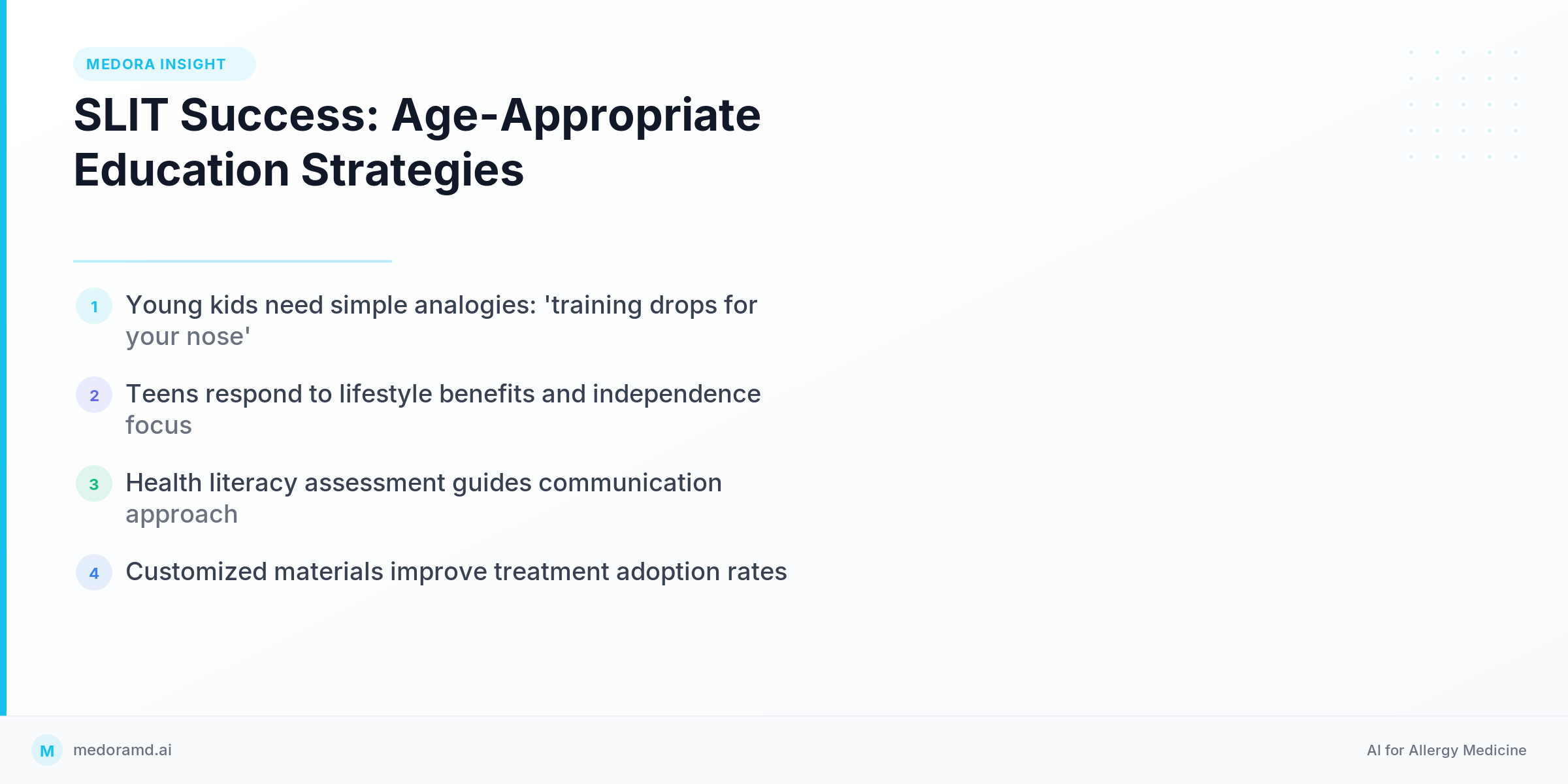
Simplifying SLIT Education: Age-Appropriate Communication Strategies That Actually Work
The Communication Gap in SLIT Success
Dr. Martinez watched as another family walked out of her clinic looking overwhelmed. She’d just explained sublingual immunotherapy (SLIT) to parents of a 7-year-old with severe grass allergies, using the same handout she gives to teenagers. The glazed look in their eyes told her everything – they weren’t ready to commit to treatment they didn’t fully understand.
This scenario plays out daily in allergy clinics nationwide. While SLIT offers tremendous benefits for pediatric patients, emerging research suggests that adoption rates improve dramatically when patient education matches both the child’s developmental stage and the family’s health literacy level. Yet most practices rely on one-size-fits-all materials that miss the mark entirely.
Why Age-Appropriate Education Matters for SLIT
Recent research in Pediatric Research examined age-stratified outcomes for sublingual immunotherapy in children with allergic rhinitis. The findings highlight something many allergists have observed clinically: treatment success isn’t just about the medication – it’s about how well families understand and engage with the therapy.
Young children (ages 5-8) need concrete, visual explanations. They understand “medicine drops under your tongue that teach your body not to be scared of grass” better than complex immunological mechanisms. Meanwhile, adolescents often respond to more detailed explanations about how SLIT works and why it’s worth the daily commitment.
The challenge compounds when considering health literacy variations among families. Research in the International Journal of Pediatric Otorhinolaryngology demonstrates that social determinants significantly impact pediatric allergy management outcomes. Families with limited health literacy need different communication approaches than those comfortable with medical terminology.
Developmental Communication Strategies That Work
Preschoolers (Ages 3-5)
– Use simple analogies: “The drops are like training for your nose”
– Focus on routine: Emphasize when and where they’ll take drops
– Visual aids: Picture schedules showing daily SLIT timing
– Parent-focused education: Detailed information goes to caregivers
School-age (Ages 6-11)
– Interactive explanations: “Your immune system is like your body’s army”
– Ownership building: Let them help with timing and tracking
– Peer comparisons: “Other kids your age do this too”
– Simple cause-and-effect: “Taking drops now means less sneezing later”
Adolescents (Ages 12-17)
– Respect autonomy: Involve them in treatment decisions
– Long-term benefits: Focus on future activities and independence
– Scientific interest: Some teens appreciate learning the mechanism
– Lifestyle integration: How SLIT fits with sports, social activities
Addressing Family Health Literacy
Effective SLIT education requires assessing not just the child’s understanding, but the entire family’s health literacy. Consider these approaches:
High health literacy families often appreciate:
– Detailed mechanism explanations
– Research citations and efficacy data
– Comparison charts with other treatments
– Access to additional reading materials
Lower health literacy families benefit from:
– Step-by-step visual instructions
– Repeated key points in simple language
– Demonstration and return demonstration
– Clear contact information for questions
Cultural and Language Considerations
The Canadian Society of Allergy and Clinical Immunology’s food allergy educator program emphasizes that effective allergy education must consider cultural context. This applies equally to SLIT education. Some families may have cultural beliefs about “building immunity” that align well with SLIT concepts, while others may need reassurance about safety and gentle immune system modification.
For non-English speaking families, professional interpretation services are essential. Machine translation of complex medical concepts often misses nuances crucial for treatment adherence.
Practical Implementation in Your Practice
Start by developing age-stratified education materials:
1. Create visual aids for younger children: Simple drawings showing drops under the tongue, calendars for tracking
2. Develop teen-focused materials: Include lifestyle benefits, independence aspects, and peer testimonials
3. Assess health literacy early: Use simple screening questions to gauge family comfort with medical information
4. Train staff consistently: Everyone should understand developmental communication principles
5. Follow up strategically: Check understanding at subsequent visits, especially in early treatment phases
The Technology Support Opportunity
This is where AI tools like Medora can meaningfully support clinical workflows. Rather than creating dozens of handouts manually, Medora’s patient instruction capabilities can generate customized SLIT education materials that match both the child’s age and the family’s communication preferences. The system can produce visual guides for younger children, detailed explanations for health-literate families, or simplified step-by-step instructions for those who need them – all while maintaining clinical accuracy and your practice’s preferred protocols.
We’re still learning how AI can best support patient education, but early testing with allergist partners suggests that customized materials save significant preparation time while improving family understanding. It’s not about replacing the crucial conversation between clinician and family – it’s about ensuring that conversation is supported by materials that actually connect.
What communication challenges have you encountered when introducing SLIT to pediatric patients and their families?
See how Medora works in a real allergy clinic.
From ambient SOAP notes to AI-assisted skin prick test reading — see what Medora can do for your practice.