
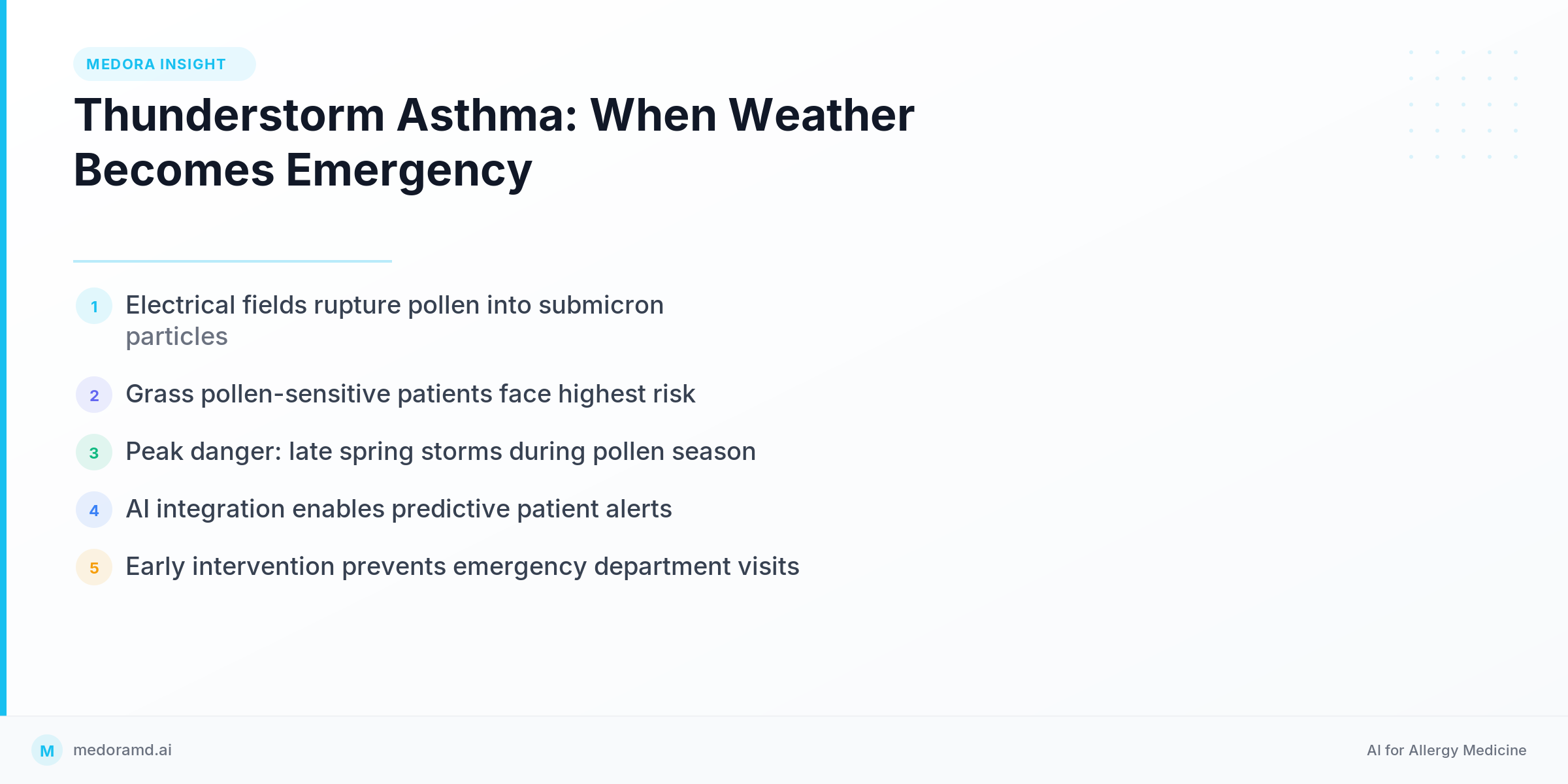
Thunderstorm Asthma: How Weather Data Integration Could Transform Emergency Preparedness
The Perfect Storm: When Weather Meets Allergy
Last spring, Dr. Sarah Chen received twelve asthma emergency calls in a single evening. All patients had well-controlled asthma. All lived within a 15-mile radius. And all experienced severe symptoms within hours of a thunderstorm that swept through their metropolitan area.
“I’d heard about thunderstorm asthma, but seeing it firsthand was eye-opening,” Dr. Chen recalls. “These weren’t patients who typically struggled with control. The atmospheric conditions created a perfect storm of airborne allergens that overwhelmed their usual management.”
Thunderstorm asthma represents one of the most dramatic examples of how environmental factors can trigger mass respiratory events. Recent research is beginning to illuminate the mechanisms behind these phenomena—and point toward opportunities for predictive intervention.
Understanding the Atmospheric Trigger
Emerging research suggests that thunderstorms create unique atmospheric conditions that can dramatically increase airborne allergen exposure. A recent study examining atmospheric charge regimes found that electrical fields and arcing during storms can cause pollen grains to rupture under both dry and wet conditions, releasing submicron particles that penetrate deeper into the respiratory tract.
These ruptured pollen fragments are small enough to bypass the upper airways and reach the lower respiratory system, where they can trigger severe bronchospasm in susceptible individuals. The timing is particularly problematic—storms often occur in the evening when many patients are outdoors or have windows open.
“What makes thunderstorm asthma so challenging is the speed and severity of onset,” explains Dr. Michael Rodriguez, an allergist who has studied environmental triggers for over a decade. “Patients who normally manage well with standard controller therapy can experience severe symptoms within minutes to hours of exposure.”
Identifying High-Risk Patients
Not all asthma patients face equal risk during thunderstorm events. Research indicates several key risk factors:
Pollen Sensitivity: Patients with documented grass pollen allergy appear at highest risk, particularly during peak pollen seasons when atmospheric pollen loads are elevated.
Geographic Location: Areas with high grass pollen counts and frequent thunderstorm activity show increased incidence of these events.
Seasonal Timing: Late spring and early summer months, when grass pollens peak and thunderstorm frequency increases, represent the highest-risk period.
Asthma Control Status: Preliminary findings suggest that even patients with well-controlled asthma may be vulnerable, though those with poor baseline control face amplified risk.
The Data Integration Opportunity
Traditional allergy practice relies on general pollen forecasts and patient-reported symptoms. But thunderstorm asthma events require more sophisticated environmental monitoring. The convergence of several data streams creates opportunities for more precise risk prediction:
Atmospheric Data: Real-time monitoring of electrical activity, humidity, and pressure changes that precede pollen rupture events.
Pollen Monitoring: Hyperlocal pollen counts that track not just overall levels but specific allergen types and particle sizes.
Weather Forecasting: Integration of meteorological data that identifies conditions conducive to thunderstorm asthma events.
Patient Risk Profiles: Individual patient data including sensitization patterns, medication adherence, and historical symptom triggers.
Clinical Implementation Challenges
While the concept of predictive alerts appears promising, several practical challenges remain:
Alert Fatigue: Too many warnings can lead to patient disengagement. Predictive systems must balance sensitivity with specificity to maintain clinical utility.
Regional Variation: Atmospheric conditions vary significantly by geography. Alert systems need local calibration to remain relevant.
Patient Response: Even accurate predictions require patients to take appropriate preventive action—increasing controller medications, staying indoors, or having rescue medications readily available.
Building Predictive Workflows
Several allergy practices have begun experimenting with environmental alert systems. Dr. Chen’s clinic now tracks local weather patterns and maintains a registry of high-risk patients for targeted outreach.
“We’ve started flagging patients with grass pollen sensitivity and sending alerts when conditions align for potential thunderstorm asthma events,” she explains. “It’s still early, but we’re seeing fewer emergency calls during high-risk periods.”
The workflow typically involves:
1. Risk Stratification: Identifying patients with documented grass pollen sensitivity and asthma
2. Environmental Monitoring: Tracking local pollen counts and weather forecasts
3. Alert Generation: Sending targeted communications when high-risk conditions develop
4. Patient Education: Providing specific guidance on preventive measures and emergency planning
The Role of AI in Environmental Health
AI tools are beginning to support these complex environmental health workflows. Platforms that integrate multiple data streams—atmospheric conditions, pollen forecasts, and individual patient risk profiles—can help clinics identify high-risk periods and patients who may benefit from proactive intervention.
Medora’s emerging environmental health capabilities exemplify this approach. By combining real-time atmospheric data with patient-specific risk factors documented in clinical notes, the platform can generate targeted alerts for thunderstorm asthma events. The AI-assisted documentation also helps practices maintain detailed environmental exposure histories, supporting more precise risk stratification over time.
These tools don’t replace clinical judgment but provide the data integration and pattern recognition that makes predictive alerting practical in busy allergy practices.
What environmental triggers do you find most challenging to predict and manage in your patient population?
See how Medora works in a real allergy clinic.
From ambient SOAP notes to AI-assisted skin prick test reading — see what Medora can do for your practice.