
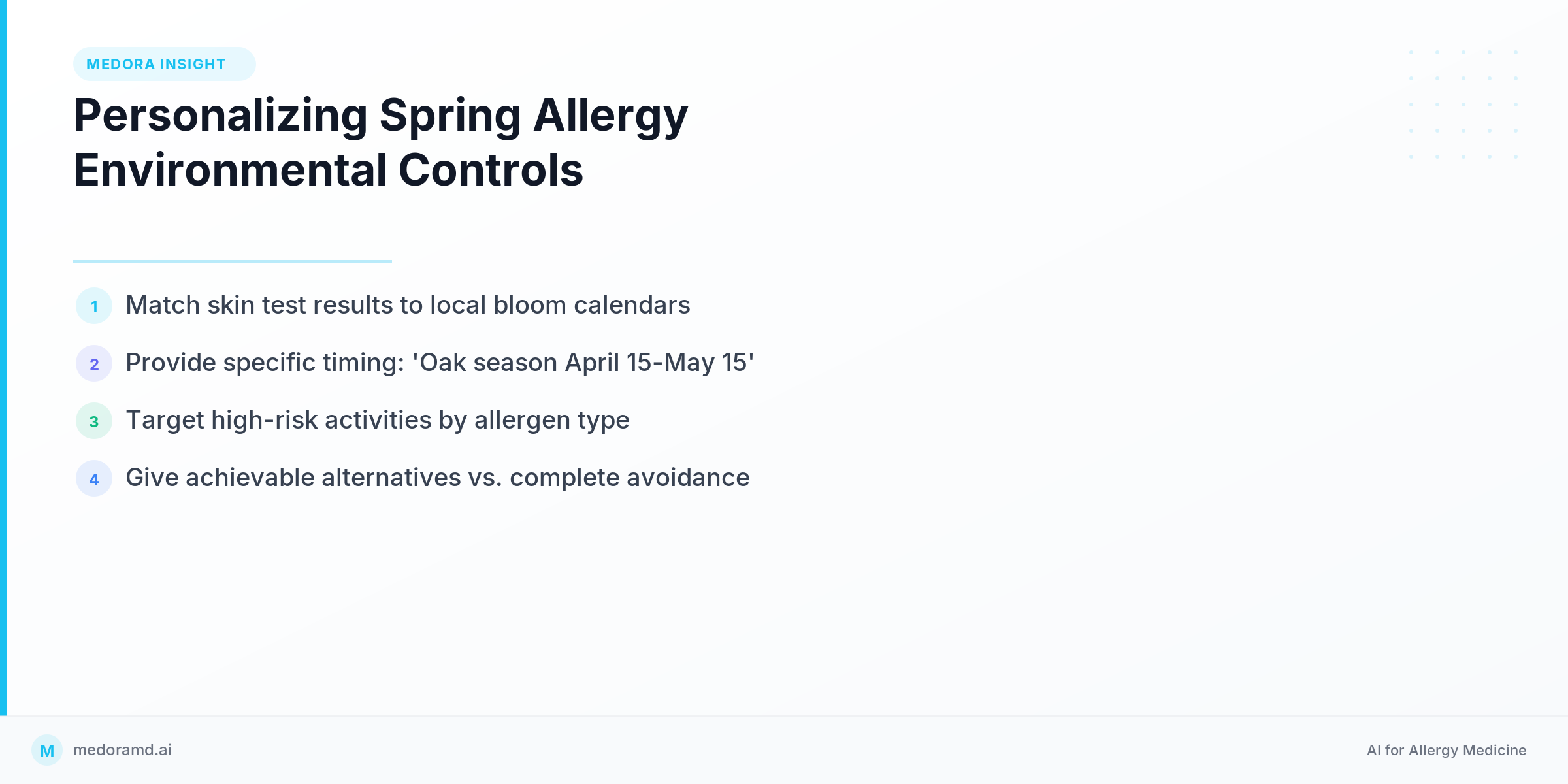
Beyond the Pollen Count: Personalizing Environmental Control Strategies for Spring Allergies
# Beyond the Pollen Count: Personalizing Environmental Control Strategies for Spring Allergies
How to translate local environmental data into actionable patient guidance that actually works
Every spring, allergists face the same challenge: patients arrive with printouts of local pollen counts, asking why their symptoms are severe when the forecast shows “moderate” levels. The disconnect isn’t in the data—it’s in how we translate environmental information into personalized, actionable advice.
Recent research in environmental control counseling reveals that generic pollen forecasts often miss the mark for individual patients. A birch-sensitive patient may struggle on a “low pollen” day if birch specifically is spiking, while a grass-allergic patient might feel fine during the same period.
The Gap Between Data and Clinical Reality
Most pollen forecasting provides aggregate counts—total particles per cubic meter of air. But allergists know that individual sensitivities vary dramatically. A patient with strong oak sensitivity and mild grass allergy needs different environmental strategies than someone with the opposite pattern.
Consider this common scenario: Maria, a 34-year-old teacher, calls your office in April reporting severe symptoms despite taking her prescribed antihistamine. The local forecast shows “moderate” pollen levels, but her skin test results from last year revealed strong reactivity to oak and maple—both of which are peaking in your region this week, even though grass pollen remains low.
Personalizing Environmental Control Strategies
Effective environmental counseling starts with matching individual sensitivities to local environmental patterns. Here’s how to structure this approach:
Start with Specific Allergen Timing
Instead of general “spring allergy” advice, map your patient’s positive skin tests to local bloom calendars. Tree pollens typically peak in early spring (March-May), grasses in late spring to early summer (May-July), and weeds in late summer to fall (August-October). But timing varies significantly by geographic region.
For patients with multiple sensitivities, identify their primary triggers during different seasonal windows. A patient reactive to oak, birch, and timothy grass needs different strategies in April (tree focus) versus June (grass focus).
Translate Weather Patterns into Action Items
General advice like “stay indoors when pollen is high” isn’t actionable. Instead, teach patients how weather affects their specific allergens:
– Dry, windy days: Highest tree and grass pollen dispersal. Recommend morning medication timing and closed windows.
– After rain: Pollen counts drop temporarily but mold spores may increase. Helpful for pollen-sensitive patients, but consider mold-allergic individuals.
– Humidity changes: Affects both pollen release and patient reactivity patterns.
Create Specific Environmental Protocols
Move beyond generic advice to targeted strategies:
For tree pollen sensitivity:
– Peak exposure times: early morning (6-10 AM)
– Highest risk activities: outdoor exercise, yard work, open windows overnight
– Protective measures: HEPA filters, shower after outdoor exposure, medication timing 30-60 minutes before anticipated exposure
For grass pollen sensitivity:
– Peak exposure times: late afternoon/early evening
– Highest risk activities: lawn mowing, sports activities, evening outdoor dining
– Protective measures: delegate lawn care, choose indoor exercise during peak season, consider pre-exposure medication protocols
Addressing Implementation Barriers
Emerging research suggests that patient adherence to environmental controls improves significantly when recommendations feel achievable. Studies indicate that overly restrictive advice (“avoid all outdoor activities”) leads to lower compliance than targeted modifications (“exercise indoors on high oak pollen days, outdoor activities okay during low-count periods”).
Make Timing Specific
Instead of “take medication daily during allergy season,” provide targeted timing: “Start daily antihistamine two weeks before oak season typically begins in our area (usually mid-March), continue through May.”
Address Real-World Constraints
Acknowledge that complete avoidance isn’t realistic. Help patients identify their highest-risk exposure scenarios and develop mitigation strategies. A landscaper can’t avoid outdoor work, but might benefit from N95 masks during peak pollen days and post-work decontamination routines.
Leveraging Technology for Personalization
Many allergists are finding that combining traditional environmental counseling with modern tools improves both accuracy and patient engagement. Real-time pollen monitoring apps can be more useful when patients understand which specific allergens to track based on their individual test results.
Some practices are exploring how AI-assisted documentation can help capture and recall individual patient sensitivities more efficiently during busy allergy seasons, ensuring that environmental counseling remains personalized even when patient volume increases.
The Communication Challenge
The most evidence-based environmental strategy fails if patients don’t understand or can’t implement it. Research in allergic rhinitis management emphasizes that successful environmental control requires ongoing communication, not just initial counseling.
Consider developing templated but customizable patient instructions that reference their specific allergen profile. Instead of generic handouts, provide guidance like: “Based on your skin test results showing oak and maple sensitivity, your highest-risk period locally is typically April 15-May 15.”
Moving Forward
Effective spring pollen communication requires moving beyond one-size-fits-all advice toward personalized environmental strategies. This means matching individual sensitivities to local environmental patterns, providing specific rather than general recommendations, and acknowledging real-world implementation challenges.
The goal isn’t perfect allergen avoidance—it’s helping patients understand their personal risk patterns and develop realistic strategies for managing exposure during their highest-risk periods.
Tools like Medora’s AI-assisted patient instruction generation can help allergists create personalized environmental guidance more efficiently, drawing from individual skin test results to generate specific recommendations about local allergen timing and exposure mitigation strategies. This allows clinicians to spend more time on complex clinical decisions while ensuring patients receive detailed, actionable environmental counseling.
What strategies have you found most effective for helping patients implement personalized environmental controls, especially when they have multiple allergen sensitivities with overlapping seasons?
See how Medora works in a real allergy clinic.
From ambient SOAP notes to AI-assisted skin prick test reading — see what Medora can do for your practice.